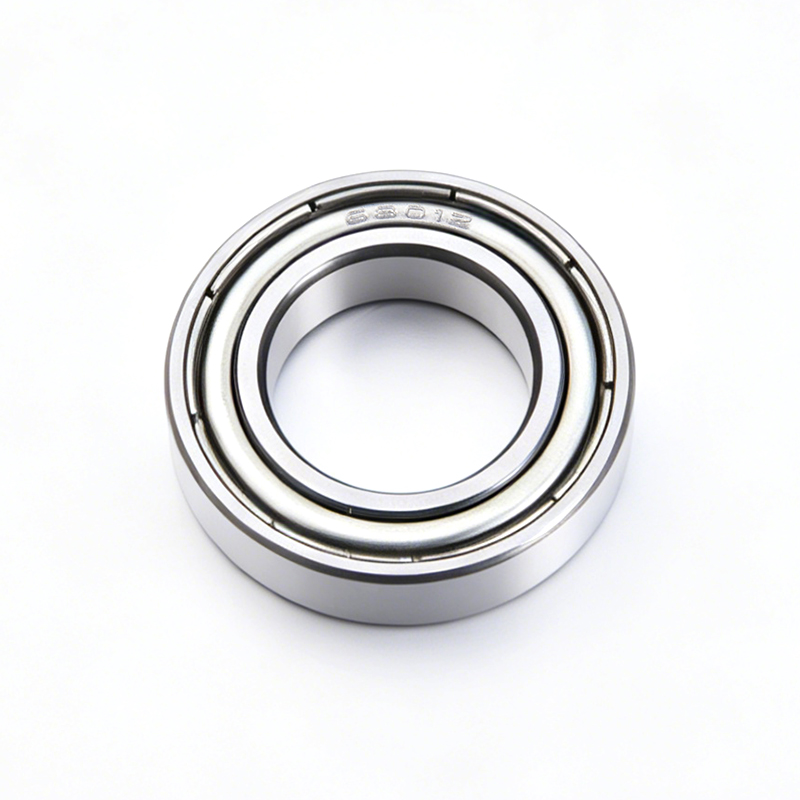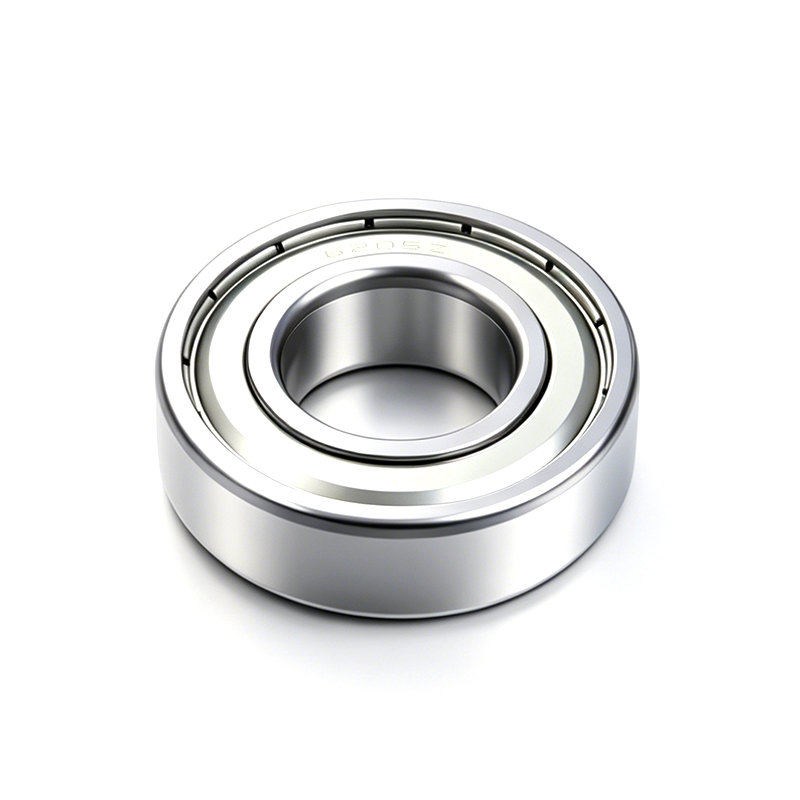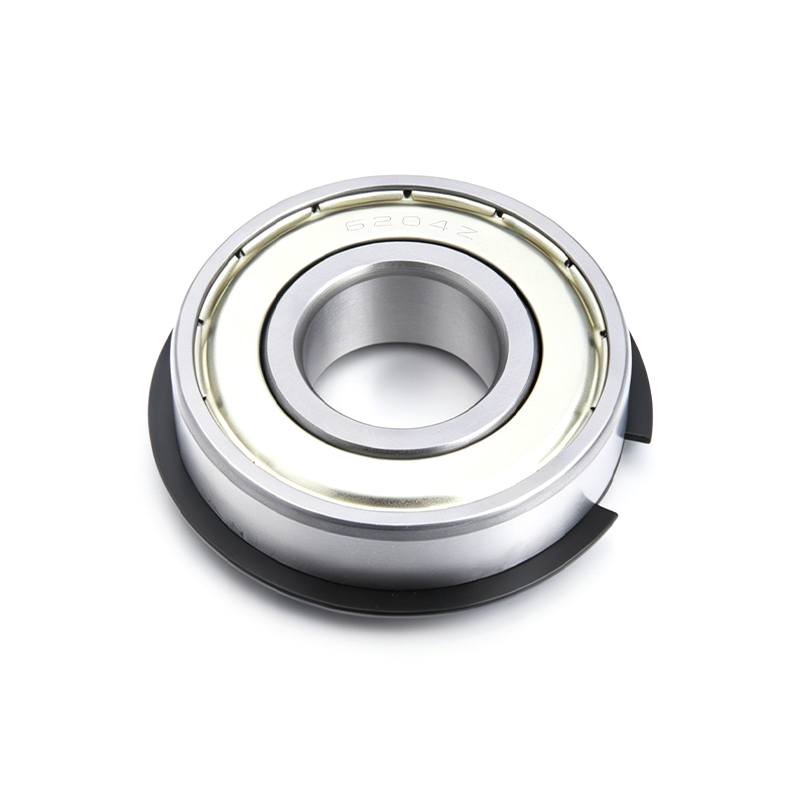
If you have ever held two ball bearings that look almost identical, then watched one drop smoothly into a housing while the other refuses to move, you already know why ball bearing sizes matter. The difference between a bearing that fits and one that does not can be a single millimetre, or a fraction of one.
This guide comes from the workshop rather than from a catalogue cover. HLGS has been making deep groove ball bearings since 2001, and the questions we receive from engineers, buyers and repair technicians keep circling the same handful of topics: what the numbers on a bearing actually mean, how to measure a bearing correctly, and how to tell whether two bearings of the same size can really be swapped.
Below you will find the three dimensions that define every ball bearing size, the bore code system that turns a model number into a measurement, charts of the most common metric sizes, and practical notes on miniature, flanged, snap ring and stainless steel variants. If you are replacing a bearing today, the measuring section near the end will get you to the right size fastest.
A ball bearing is never described by one size. It is described by three, and all three have to match before the bearing will seat properly and run quietly. In drawings and catalogues you will see them written as d, D and B.
Sizes are normally written as bore × outer diameter × width, so a 6204 is 20 × 47 × 14 mm. Those three figures follow the bearing everywhere: on the box, on the drawing, and on the purchase order. When someone asks for "the size of a 6204", this is the answer they need.
| Symbol | Dimension | Fits | 6204 value |
|---|---|---|---|
| d | Bore diameter | Shaft | 20 mm |
| D | Outer diameter | Housing | 47 mm |
| B | Width | Axial space | 14 mm |
There is good news for anyone comparing suppliers. Ball bearing boundary dimensions are standardised internationally, in ISO 15 and in the equivalent JIS and DIN documents. A 6204 from one factory and a 6204 from another should both measure 20 × 47 × 14 mm, which is why a replacement can often be ordered from a different manufacturer without redrawing anything.
Remember: size gets you a bearing that fits. It does not, on its own, guarantee a bearing that performs the same. Seals, clearance and tolerance class decide the rest, and we come back to that later in this article.
The fastest way to identify a ball bearing size is to read the number stamped on the shield. For metric deep groove ball bearings, the last two digits are the bore code, and there is a simple rule for converting that code into millimetres.
| Bore code | Bore (mm) | Example model |
|---|---|---|
| 00 | 10 | 6000 |
| 01 | 12 | 6201 |
| 02 | 15 | 6202 |
| 03 | 17 | 6203 |
| 04 | 20 | 6204 |
| 05 | 25 | 6205 |
| 06 | 30 | 6206 |
| 08 | 40 | 6208 |
| 10 | 50 | 6210 |
The digits in front of the bore code tell you what kind of bearing it is and how heavy the cross section is. In a number such as 6204, the leading 6 means a single row deep groove ball bearing, the 2 is the diameter series, and 04 is the bore code. Change the middle digit and you change the outside of the bearing while the shaft fit stays exactly the same.
Two bearings can share the same bore and still be completely different components. The series decides how much radial space the bearing occupies and how much load it can carry. This is the single most useful comparison when a design is tight on room, because it shows exactly what you gain and give up by stepping from one series to another.
| Model | Series type | Bore d (mm) | Outer D (mm) | Width B (mm) | Load character |
|---|---|---|---|---|---|
| 6804 | Extra thin | 20 | 32 | 7 | Lightest |
| 6904 | Thin | 20 | 37 | 9 | Light |
| 6004 | Extra light | 20 | 42 | 12 | Light to medium |
| 6204 | Light | 20 | 47 | 14 | Medium |
| 6304 | Medium | 20 | 52 | 15 | Medium to heavy |
| 6404 | Heavy | 20 | 72 | 19 | Heavy |
Read that table from top to bottom and the trade-off is plain. The 6800 series is the thinnest option for tight assemblies, while the 6300 and 6400 series bring thicker rings, larger balls and higher load capacity at the cost of space. As a rule of thumb, choose the lightest series that fits when the application is quiet and lightly loaded, and move up a series when the bearing has to absorb shock or carry continuous radial load.
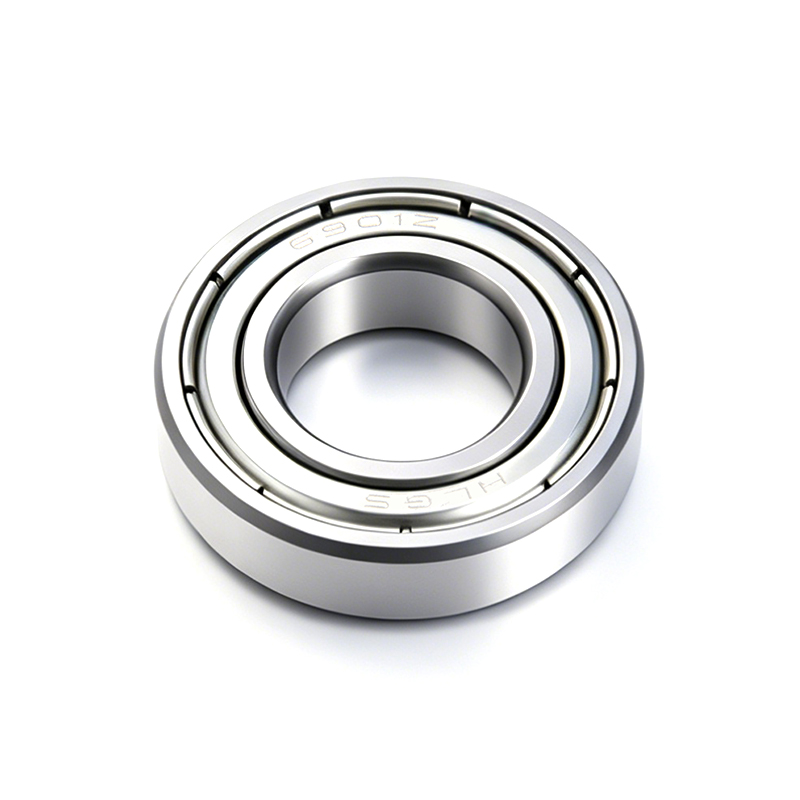
6901ZZ Thin-Section Deep Groove Ball BearingA 12 mm bore, 24 mm outer diameter and 6 mm width make this shielded bearing suitable for compact fans, small motors and electronic devices.View Product →
Our own 6901ZZ shows why the thin series exists. It pairs a 12 mm bore with a 24 mm outer diameter in a 6 mm width, which is why it appears so often in fans, small motors and electronic devices where a 6201 would simply not fit into the available space.
The sizes below are the ones that turn up most often in drawings, repair kits and replacement orders. If you measure an unmarked bearing and it matches one of these rows, you have very likely found your size.
| Model | Bore d (mm) | Outer D (mm) | Width B (mm) | Often found in |
|---|---|---|---|---|
| 623 | 3 | 10 | 4 | Instruments, small tools |
| 607 | 7 | 19 | 6 | Small motors, fans |
| 608 | 8 | 22 | 7 | Skate wheels, motors, rollers |
| 688 | 8 | 16 | 5 | Compact mechanisms, models |
| 698 | 8 | 19 | 6 | Small tools |
| 6801 | 12 | 21 | 5 | Precision equipment, thin assemblies |
| 6901 | 12 | 24 | 6 | Fans, motors, electronics |
| 6001 | 12 | 28 | 8 | Small motors, blowers |
| 6200 | 10 | 30 | 9 | Power tools, appliances |
| 6201 | 12 | 32 | 10 | Motors, pumps, appliances |
| 6202 | 15 | 35 | 11 | Household appliances, tools |
| 6203 | 17 | 40 | 12 | Motors, tools, drive units |
| 6205 | 25 | 52 | 15 | Industrial motors, pumps, machinery |
| 6305 | 25 | 62 | 17 | Heavier duty motors and machinery |
Once a row matches, confirm it by checking the markings on the shield, the number of shields or seals, and whether there is a groove or flange on the outer ring. A 608 and a 688 share the same 8 mm bore but have different outer diameters, so a caliper check on the outside takes only a moment and prevents an expensive mistake.
Miniature bearings cover bores from about 1 mm up to roughly 10 mm. In this part of the range, small differences in the outer diameter matter enormously, because the surrounding mechanism is often only a few millimetres thick. Compare a 688 and a 608: the bore is 8 mm in both cases, but the outer diameter is 16 mm against 22 mm, and that 6 mm difference decides whether the design closes.
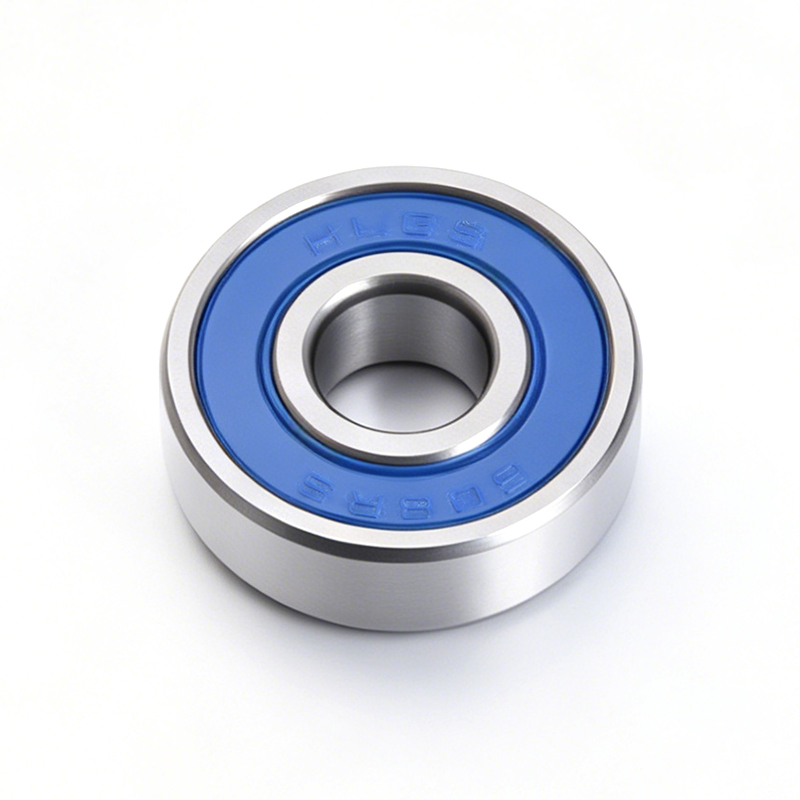
608-2RS Miniature Deep Groove Ball BearingThis widely used 8×22×7 mm miniature bearing matches a standard 8 mm bore and suits designs needing a 22 mm outer diameter.View Product →
The 608-2RS is probably the most widely recognised miniature size in the world at 8 × 22 × 7 mm, with two rubber seals to keep dust where it belongs. It is a good example of why the same bore appears in so many different outer profiles: the shaft size is standard, but the surrounding hardware is not.
Thin section thinking continues above 10 mm. The 6800 and 6900 series keep the outer diameter low, and the SMR family goes further still. Our SMR148-2RS measures just 8 × 14 × 4 mm, which is what makes it usable inside small motors and compact robotic joints where nothing larger will go. When space is the binding constraint, always start from the outer diameter rather than the bore.
If you work regularly with this end of the range, our article on how miniature bearings power precision engineering and high speed machinery goes deeper into speed limits and selection.
Once the bore and outer diameter are fixed, manufacturers still have room to change how a bearing mounts and what it is made of. These variants keep standard boundary dimensions but alter the outer profile or the material, and they solve problems that a plain bearing cannot.
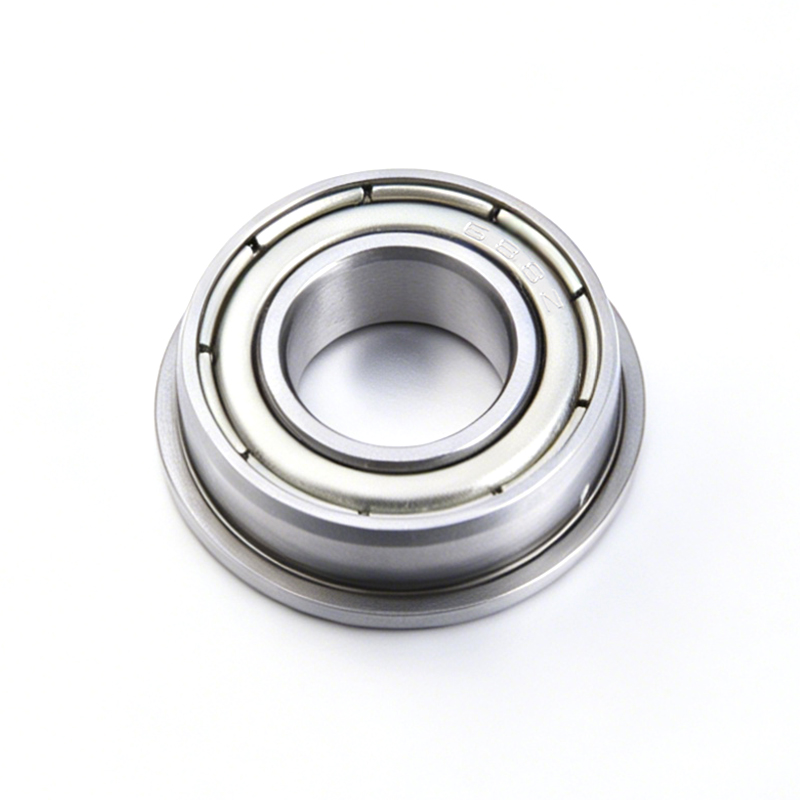
A flange is a small shoulder formed on the outer ring. Our F688ZZ keeps the familiar 8 × 16 × 5 mm envelope of a standard 688 but adds a flange, so the bearing can sit against a flat face in the housing instead of relying on a machined shoulder. In designs with thin walls or pressed housings, that flange often removes an entire machining operation.
F688ZZ Flanged Miniature Deep Groove Ball BearingWith an 8×16×5 mm envelope and a 17.5 mm flange, this shielded bearing simplifies axial location in thin-walled or pressed housings.View Product →
Snap ring versions such as our 6000ZZNR and 6200ZZNR carry a groove in the outer ring plus a spring ring. The bearing presses into a plain through-bore and is located axially by the ring, which simplifies the housing considerably. Note that the ring extends beyond the nominal outer diameter, so the housing bore has to be sized for the ring, not only for D.
Stainless bearings use an S prefix, as in S607ZZ or S695-2RS. Their nominal dimensions follow the same standards as chrome steel equivalents, so an S688-2RS shares the 8 × 16 × 5 mm envelope of a 688ZZ. What changes is corrosion resistance, and in some cases load rating and limiting speed. Whenever moisture, cleaning agents or food contact are involved, the stainless option is usually worth the difference in price.
The overwhelming majority of ball bearings are manufactured to metric dimensions, and if you are buying new parts in Europe or Asia, metric is almost certainly what you will receive. Inch sizes survive in older machinery, in some instrumentation work, and in a handful of consumer products where the original design predates metric conversion.
| Designation | Bore (inch) | Bore (mm) | Typically found in |
|---|---|---|---|
| R6 | 3/8 | 9.525 | Small machinery, instruments |
| R8 | 1/2 | 12.7 | Older motors, hobby equipment |
| R10 | 5/8 | 15.875 | Legacy industrial equipment |
| 1616 | 1/2 | 12.7 | Instrumentation, light assemblies |
If you are converting, remember that one inch equals 25.4 mm, and that a converted figure is not a substitute part. A 9.525 mm bore is not the same as a 10 mm bore, and forcing the wrong bearing onto a shaft damages both components. Measure in millimetres, note the fractional equivalent if you need it, and order against the original designation whenever it is known.
When the marking has worn off or the bearing came out of an unlabelled assembly, measurement is the only route left. Work through the following steps in order and write each figure down before moving on.
Compare your three figures against a standard chart. Bearing dimensions are made to tolerances measured in thousandths of a millimetre, so a reading of 7.98 mm on a bore is much more likely to be a nominal 8 mm bearing than a special size. If a measurement falls between two standard values, re-measure before assuming you have something unusual on your hands.
Matching d, D and B gives you a bearing that installs. It does not give you a bearing that behaves identically. Suffixes and tolerance classes sit on top of the size and change friction, clearance, load capacity and noise, so two bearings with identical boundary dimensions can perform very differently in the same application.
| Marking | Meaning | Effect on size |
|---|---|---|
| ZZ | Two metal shields | Boundary dimensions unchanged |
| 2RS | Two rubber seals | Boundary dimensions unchanged, higher friction |
| NR | Snap ring groove and ring | Ring extends beyond the outer diameter |
| C3 | Increased internal clearance | No change to d, D or B |
| S (prefix) | Stainless steel rings | Same nominal dimensions |
| F (prefix) | Flanged outer ring | Adds a flange to the outer profile |
| MR (prefix) | Miniature metric series | Very thin section for the bore |
A C3 bearing has more internal clearance than a standard CN bearing. That matters when a shaft or housing expands with heat, or when a press fit closes up the running clearance. Fitting a C3 bearing where a standard one was specified usually increases noise, while fitting a standard clearance bearing into a hot application can lead to preload, heat and early failure.
Standard production bearings and precision grade bearings can share a size but not a tolerance band. Higher grades control runout and dimensional consistency more tightly, which shows up as quieter running and better performance at speed.
A metal shielded bearing turns more freely than a rubber sealed one, but it keeps less contamination out. In a dusty environment the sealed version lasts longer; in a high speed, low torque application the shielded version may be the better choice. The size is the same either way, which is exactly why the suffix deserves a second look.
Selecting a size is a process of elimination rather than a guess. Start with the shaft, because the bore is normally fixed by the shaft diameter and cannot be changed without redesigning the assembly. Then look at the space available for the outer ring, then at the load and speed the application demands, and finally at the environment.
Typical bore size ranges by application
The chart above is a starting point, not a rule. It shows where most bearings of a given bore end up, but the deciding factor is always the combination of load, speed and available space. Once the bore is fixed, the series is your main lever: a 6204 and a 6004 fit the same shaft, yet the lighter series leaves more material in the housing wall and the heavier series carries more load.
A few practical checks before you commit to a size:
From the manufacturing side, standard sizes are a shared language. HLGS is the trademark of Ningbo Zhenhai Hualei Bearing Co., Ltd., a manufacturer established in 2001, with a mechanical and electrical technology arm, Ningbo Hotex Mechanical & Electrical Technology Co., Ltd., set up in 2016. Our range covers deep groove ball bearings, miniature and small sized bearings, flanged bearings, snap ring bearings, stainless steel bearings and nonstandard designs, and every one of them is built to the boundary dimensions discussed in this article.
Because we are a direct manufacturer, we can also step outside the standard chart. When a housing is too small for a 6200 but too large for a 6900, a nonstandard bearing made to a drawing or a sample is often the cheaper answer than redesigning the assembly. That is where OEM and ODM work usually starts: a customer sends dimensions, a load requirement and a target life, and we work back to the ring and ball sizes that meet them.
Quality control follows the ISO 9001 and ISO/TS 16949 management systems, products are tested on calibrated equipment before dispatch, and environmental and product standards are observed as part of normal production. Sizes can be verified on the drawing, on the inspection report and on the finished bearing itself, which is what a purchasing engineer really needs.
If you would like to see the range organised the way this article is, you can browse our deep groove ball bearing range and match the charts above to the models we produce every day.
Bore diameter (d), outer diameter (D) and width (B). They are written as bore × outer diameter × width, so a 6204 measures 20 × 47 × 14 mm. All three figures must match for the bearing to fit correctly.
Take the last two digits. Codes 00, 01, 02 and 03 mean 10, 12, 15 and 17 mm. From 04 upward, multiply by five: 04 is 20 mm, 05 is 25 mm and 08 is 40 mm. For miniature bearings below 10 mm, the number usually states the bore directly, as with the 608 and its 8 mm bore.
Most ball bearings are metric. Inch sizes still appear in older equipment and some instrumentation, generally as R numbers or fractional bore designations. One inch equals 25.4 mm, but a converted figure never replaces a genuine inch size in a precision fit.
No. Both fit a 20 mm shaft, but the 6004 has a 42 mm outer diameter and a 12 mm width, while the 6204 measures 47 mm and 14 mm. Swapping them requires a change to the housing, and the lighter series also carries less load.
They describe the sealing. ZZ means two metal shields, which run freely and keep larger debris out. 2RS means two rubber seals, which resist dust and moisture better but add friction and reduce limiting speed. The three boundary dimensions stay the same.
Yes. Nonstandard bearings are made to a drawing or a sample, with custom bore, outer diameter, width, flange or groove features. This is common when an existing housing cannot be modified but the standard range does not offer a suitable fit.
Bearings are made to tolerances measured in thousandths of a millimetre, so a reading within a hundredth of a millimetre of a standard value is usually that standard size. Measure at several points, use a clean caliper, and repeat the reading before concluding that you have an unusual bearing.
Miniature bearings are produced with bores of 1 mm and below in some series. In our own range the smallest common bore is 3 mm, as in the 623, with thin section options such as the SMR148-2RS at 8 × 14 × 4 mm for assemblies that are tight on space.
Ball bearing sizes come down to three numbers, one simple bore code rule and a measuring routine that takes a couple of minutes. Once you can read a model number and confirm it with a caliper, most of the uncertainty around replacement and selection disappears. Start with the bore, choose the lightest series that satisfies the load, then check the seal type and clearance class before you order.
If a standard size will not do the job, that is not a dead end. Send us the dimensions, the application and the running conditions, and we will help you find the closest standard bearing or design something that fits exactly.
Picture a small electric motor bolted to the housing of a pump. The belt is tensioned, the shaft is...
The Direct Answer: A Deep Groove Ball Bearing Supports Both Radial and Axial Loads Using a Simple, ...
Imagine a small electric motor in a kitchen appliance that starts making a grinding noise after a f...
A motor that has run for years rarely announces a bearing failure early. The first sign is a low hu...