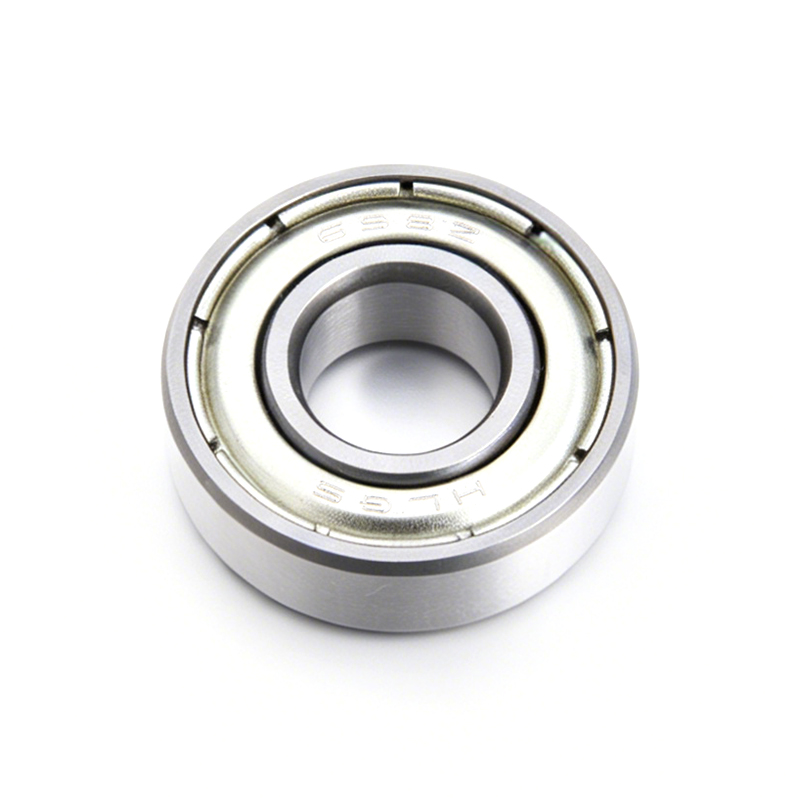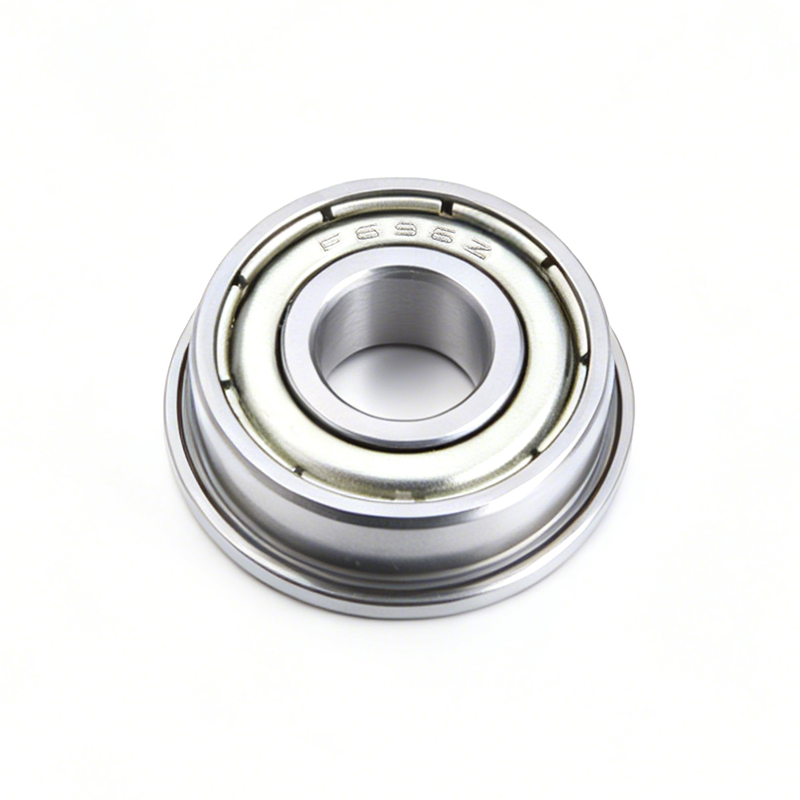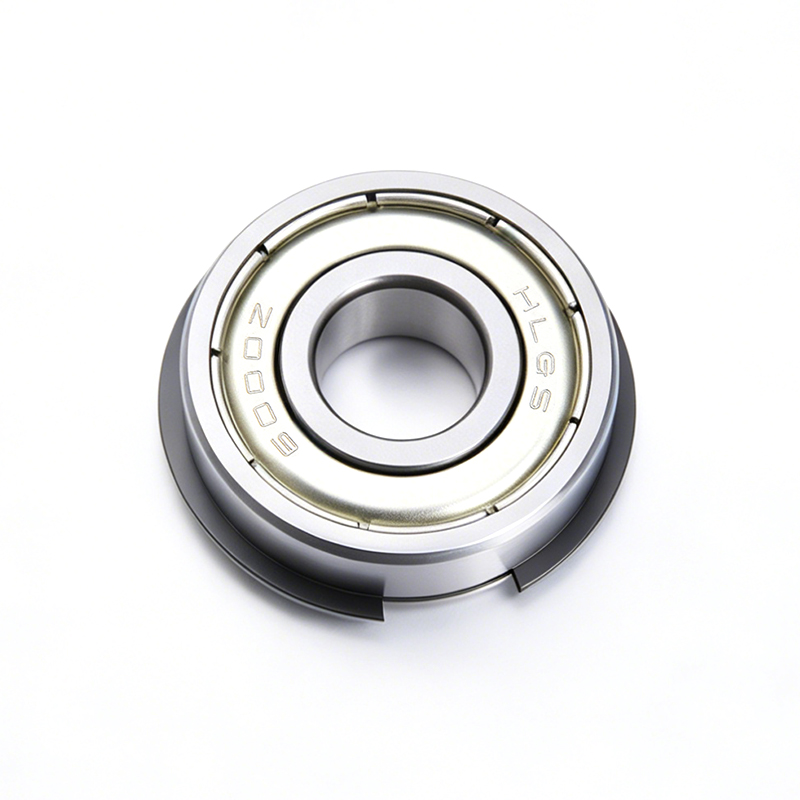
A deep groove ball bearing is a single row rolling element bearing whose inner and outer raceways form a continuous groove deep enough to hold the ball centered under both radial and moderate axial load. It is the most widely produced bearing ball bearing type in the world, used anywhere a shaft needs to spin smoothly, quietly, and at low friction.
A deep groove ball bearing is a rolling element bearing built from an inner ring, an outer ring, a set of steel balls, and a cage, where the raceway grooves on both rings are machined slightly larger than the ball radius so the ball sits in a deep, close-fitting channel. That geometry is what lets a deep groove ball bearing carry radial load, axial load in both directions, and high rotational speed inside one compact part.
The name comes directly from the shape of the raceway. In a plain radial bearing the groove is shallow and only resists load pushing straight through the shaft. In a deep groove ball bearing the groove radius is cut only marginally larger than the ball itself, usually within a few percent, so the ball never has room to climb out of the channel even when the shaft pushes sideways. That single geometric decision is why deep groove ball bearings became the default choice across almost every machine category, from a kitchen blender motor to a conveyor gearbox.
When people search for a bearing ball or a bearing ball bearing without knowing the technical name, they are almost always describing this exact part. It is the bearing most engineers picture first because it appears in more catalog pages, more OEM drawings, and more replacement parts lists than any other rolling bearing family.
A deeper groove increases the contact arc between ball and raceway. More contact arc spreads the load over a larger area, which raises both the radial and axial load rating without increasing the outer dimensions of the bearing.
Because the balls roll rather than slide, and because the design needs no separate thrust component, friction stays low. That low friction is the main reason deep groove ball bearings tolerate the highest speed factors of any common bearing type.
Every deep groove ball bearing, no matter how small or large, is built from the same five functional parts. Understanding each one makes it much easier to read a bearing size chart or a bearing dimensions chart later, because every dimension on that chart maps to one of these components.
Note: the term ball bearing is often used loosely to describe the whole assembly, while bearing ball on its own usually refers only to the loose steel ball component sold separately for repair or regreasing work.
A deep groove ball bearing works on a point contact principle. Each steel ball touches the inner raceway at one point and the outer raceway at one point, and load passes through those two tiny contact patches instead of across a full line, the way it would in a roller bearing. Point contact keeps rolling resistance low, which is why deep groove ball bearings spin more freely than almost any other bearing family of the same size.
Because the raceway groove is deep on both rings, the line connecting the two contact points is not perfectly straight through the center of the ball, it sits at a small angle, often quoted as roughly zero degrees at rest but shifting slightly under axial load. That shifting contact angle is what allows a single row deep groove ball bearing to resist thrust from either direction without needing a second, opposing bearing. A tapered roller bearing or an angular contact bearing needs to be paired to handle two way thrust. A deep groove single row ball bearing does it alone, in one part, at one price.
Radial load pushes straight down through the shaft into the housing. The full circle of balls shares this load, with the balls directly under the load line carrying the largest share.
Axial load pushes along the shaft centerline. The deep groove lets the contact points shift slightly so a portion of every ball still resists the thrust, in either direction.
Most of what people mean by a deep groove ball bearing is the single row deep groove ball bearing, which is by far the more common configuration. A double row version doubles the ball complement in one wider bearing, which raises radial capacity without stacking two separate single row bearings on the shaft. The table below lines up the two configurations side by side.
| Feature | Single row deep groove ball bearing | Double row deep groove ball bearing |
| Ball rows | 1 | 2 |
| Typical width | Narrow, standard series | Roughly 1.3 to 1.6x the width of a single row equivalent |
| Radial capacity | Baseline | Roughly 1.5 to 1.8x higher |
| Axial capacity | Moderate, both directions | Higher, both directions |
| Cost per unit | Lower | Higher |
| Common use | Electric motors, pumps, gearboxes, appliances | Heavy pulleys, high radial load fans, textile machinery |
In practice, deep groove single row ball bearings cover more than nine out of ten industrial applications, because most shafts do not need the extra radial margin a double row design provides. Double row bearings are reserved for situations where space along the shaft is limited but the radial load is unusually high.
Ask any bearing engineer what are deep groove ball bearings good for and the answer is almost always the same: everything that is not an extreme case. They are not the highest load bearing available, and they are not the fastest bearing available, but they are the best all around compromise between load, speed, cost, and simplicity, which is exactly why global production volume for this single bearing type outpaces every other rolling bearing family combined.
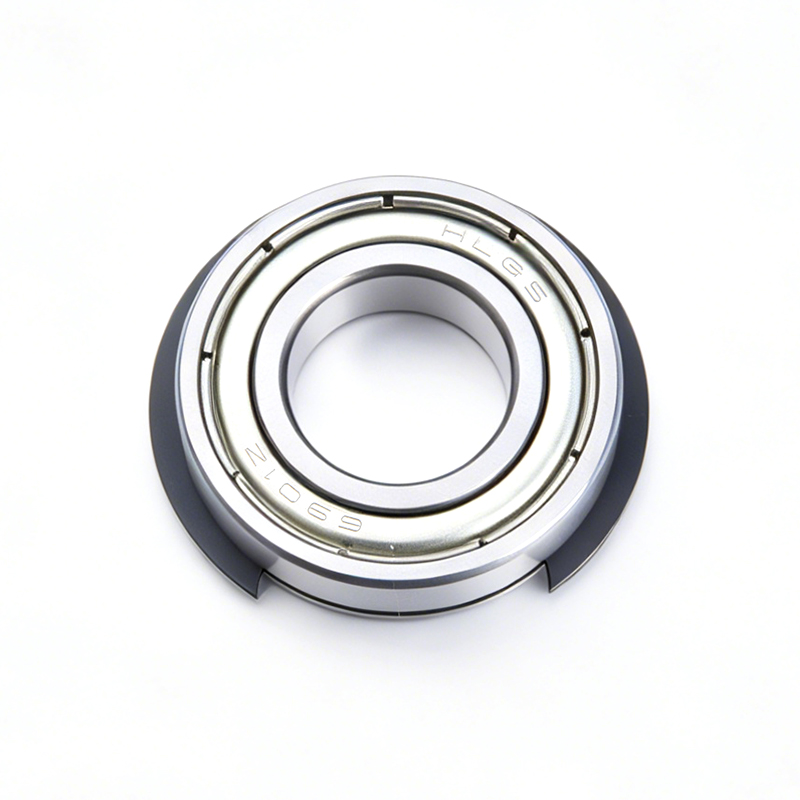
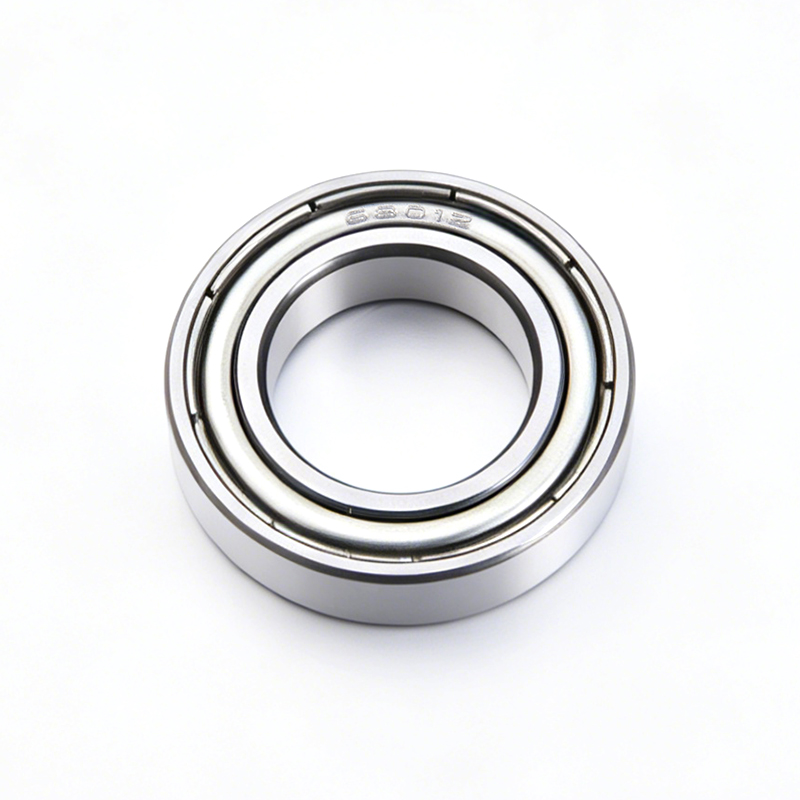
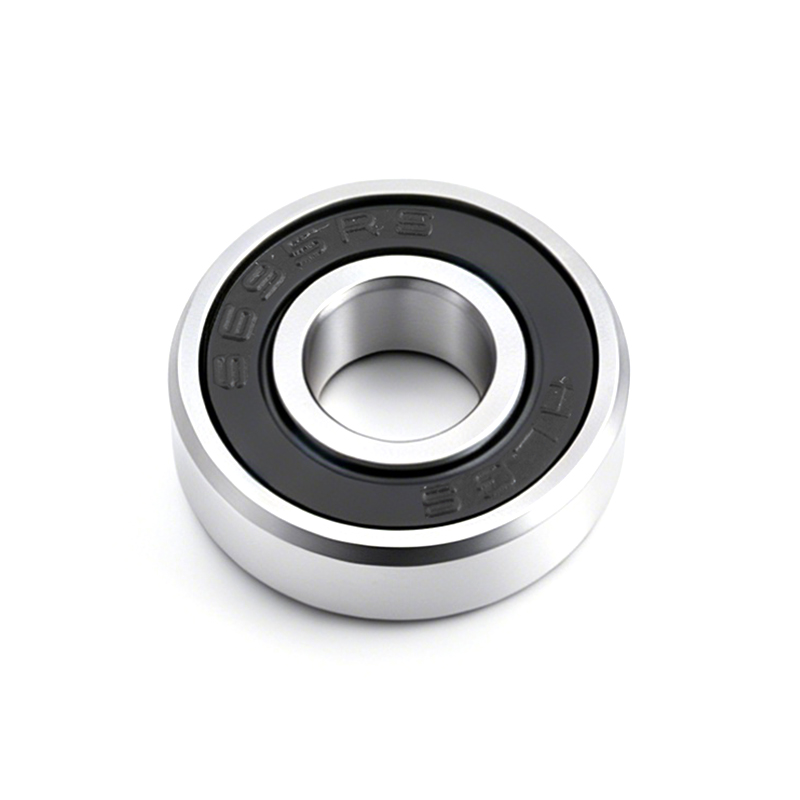
A deep groove ball bearing can be supplied with several different protection levels, and the suffix letters after the size number tell you which one you are holding. This matters as much as the raw dimensions when you are matching a replacement bearing ball bearing to a machine.
| Suffix | Protection type | Best suited for |
| Open | No shield or seal, packed with grease by the user or oil bath lubricated | Clean, controlled environments with a dedicated lubrication system |
| ZZ / 2Z | Metal shields on both sides, non contact | Light dust protection, higher speed than sealed types |
| RS / 2RS | Rubber seals on both sides, light contact | General industrial and appliance use, keeps grease sealed for life |
| RZ / 2RZ | Rubber seals, low friction non contact design | Higher speed applications that still need seal level protection |
Every deep groove ball bearing is described by three core measurements: bore diameter, outside diameter, and width. Together these three numbers make up the bearing dimensions chart that appears on every manufacturer datasheet. The table below is a standard ball bearing size chart for the most common metric series, covering the 60 extra light, 62 light, and 63 medium series.
| Bearing number | Bore (mm) | Outside dia (mm) | Width (mm) | Dynamic load (kN) | Limiting speed (grease, rpm) |
| 6000 | 10 | 26 | 8 | 4.6 | 28000 |
| 6001 | 12 | 28 | 8 | 5.1 | 26000 |
| 6002 | 15 | 32 | 9 | 5.6 | 24000 |
| 6003 | 17 | 35 | 10 | 6.0 | 22000 |
| 6004 | 20 | 42 | 12 | 9.4 | 19000 |
| 6200 | 10 | 30 | 9 | 5.1 | 26000 |
| 6201 | 12 | 32 | 10 | 6.8 | 24000 |
| 6202 | 15 | 35 | 11 | 7.6 | 22000 |
| 6203 | 17 | 40 | 12 | 9.6 | 20000 |
| 6204 | 20 | 47 | 14 | 12.7 | 18000 |
| 6205 | 25 | 52 | 15 | 14.0 | 16000 |
| 6300 | 10 | 35 | 11 | 7.6 | 22000 |
| 6301 | 12 | 37 | 12 | 9.7 | 20000 |
| 6302 | 15 | 42 | 13 | 11.4 | 19000 |
| 6303 | 17 | 47 | 14 | 13.5 | 17000 |
| 6304 | 20 | 52 | 15 | 15.9 | 15000 |
Figures above are representative catalog level values used for general comparison. Always confirm exact bearing sizes and bearing dimensions against the current manufacturer datasheet before ordering, since load ratings vary slightly between production standards.
A code such as 6205-2RS-C3 packs bearing sizes and options into one string. Breaking it apart makes the whole bearing dimensions chart easier to use going forward.
| Code segment | Meaning |
| 62 | Series and type, here a light series deep groove ball bearing |
| 05 | Bore code, multiply by 5 to get bore in mm, so 05 equals 25mm |
| 2RS | Rubber seals fitted on both sides |
| C3 | Internal clearance class, C3 is looser than the standard clearance |
The rings and balls in a standard deep groove ball bearing are made from chrome alloy bearing steel, most commonly grade GCr15, which is through hardened to roughly 60 to 64 HRC. That hardness lets the small ball to raceway contact patch handle repeated stress cycles without deforming. Cages are typically stamped steel for smaller bore bearings and machined brass or engineered polymer for larger or higher speed bearings.
The standard material for the vast majority of deep groove ball bearings. Good hardness, good fatigue life, and low cost make it the default across industrial and consumer equipment.
Used where moisture or mild corrosive exposure is a concern, such as food processing lines, marine equipment, and outdoor machinery.
Silicon nitride balls paired with steel rings reduce weight and friction further, used in high speed spindles and specialized electric motor designs.
Reduces cage mass and friction at high speed, common in electric motor bearings that must run quietly for long service intervals.
The honest answer to what are deep groove ball bearings used for is almost anything that spins. Because the design handles radial load, moderate thrust in both directions, and high speed all in one compact and inexpensive part, it became the go to rotating support across nearly every industry that builds machinery.
| Industry | Typical location | Why deep groove ball bearings fit |
| Electric motors | Drive end and non drive end shaft support | High speed, low noise, low friction heat |
| Automotive | Alternators, water pumps, gearbox shafts, wheel hub subassemblies | Compact size, reliable under vibration |
| Home appliances | Washing machine drums, fans, blenders, vacuum motors | Low cost, quiet running, long grease life |
| Agricultural machinery | Gearboxes, pump shafts, conveyor rollers | Tolerant of dust with sealed variants |
| Industrial fans and pumps | Impeller shaft support | High limiting speed, good axial capacity |
| Conveyor systems | Roller and pulley shafts | Simple mounting, wide size range |
| Power tools | Motor shaft and gear stage support | Small envelope, high speed capability |
| Textile machinery | Spindles and roller shafts | Precision running, low vibration |
Measure the shaft diameter for bore size and the housing bore for outside diameter, then cross reference against a bearing sizes chart to shortlist candidate part numbers.
Add up the actual forces the bearing will see in operation, including any belt tension or gear mesh force, not just the static weight of the rotating assembly.
Compare your operating rpm against the limiting speed column of the ball bearing dimensions chart, then apply a safety margin for grease life and ambient temperature.
Pick open bearings only if you have a controlled lubrication system, otherwise choose 2RS or ZZ based on the dust, moisture, and speed profile of the environment.
Standard clearance suits most general purpose work, while C3 clearance is common for electric motors that run hot and need extra internal room.
ABEC or ISO P0 tolerance is fine for general machinery, while precision spindles and high speed equipment need P6 or tighter.
Always press against the ring being fitted, the inner ring when mounting onto a shaft and the outer ring when pressing into a housing, so force never passes through the balls.
For an interference fit, heating the bearing to roughly 80 to 100 degrees Celsius lets it slide onto the shaft without force, then it shrinks into place as it cools.
Sealed bearings are typically greased for life, while open and shielded bearings on continuous duty equipment usually need regreasing every three to twelve months depending on speed and temperature.
Shaft and housing must stay concentric within the bearing manufacturer tolerance, since misalignment concentrates load on a narrow band of the raceway and shortens fatigue life sharply.
| Symptom | Likely cause | Prevention |
| Grinding or roughness | Contamination inside the raceway | Switch to a sealed variant, improve housing sealing |
| Overheating | Over greasing or too tight a fit | Follow fill quantity guidance, verify fit tolerance |
| Flaking or spalling | Fatigue from sustained overload | Recheck load calculation, upgrade to a higher capacity series |
| Rust marks on raceway | Moisture ingress or storage humidity | Use sealed bearings, store in original packaging |
| Loose fit, shaft slip | Undersized shaft or worn housing bore | Confirm tolerance against ISO fit tables before mounting |
Consistent dimensions, verified steel grade, and stable heat treatment matter just as much as the numbers printed on a bearing dimensions chart. A supplier that runs its own forging, turning, heat treatment, and grinding lines can hold tolerance and load rating far more consistently than a trading company that only repackages bearings from mixed sources.
Ningbo Zhenhai Hualei Bearing Co., Ltd. manufactures deep groove ball bearings across the 60, 62, and 63 series, along with open, ZZ, and 2RS sealing variants, sized from small instrument bore bearings up to medium industrial bore bearings. The company is a practical option for buyers who need dependable bearing sizes, stable supply volume, and support matching a bearing ball bearing to an existing drawing or replacing an obsolete part number.
It supports a rotating shaft against radial load and moderate side to side thrust at the same time, which is why it shows up in motors, pumps, fans, and appliance drums rather than in equipment built only for pure thrust or extremely heavy radial load.
Deep groove ball bearings favor speed and low friction, while roller bearings favor higher radial capacity at lower speed. Most general machinery uses deep groove ball bearings unless the load is unusually heavy for the available shaft size.
The last two digits of most standard part numbers give the bore in millimeters when multiplied by five, and the series digits in front indicate the outside diameter and width family, both of which are listed on a standard bearing size chart.
Only if the radial load is within the single row rating. A single row deep groove ball bearing has lower radial capacity than a double row unit in the same outside diameter, so the load calculation should always be rechecked before substituting.
A bearing ball is the individual steel sphere, sold loose for repair or regreasing work. A ball bearing is the complete assembly, rings, balls, and cage together, ready to mount on a shaft.
Service life depends on load, speed, lubrication, and alignment, but a correctly selected and properly mounted deep groove ball bearing under normal industrial duty commonly runs for several years before the raceway shows fatigue.
A deep groove ball bearing is the everyday workhorse of rotating machinery. Its deep raceway groove lets one compact, affordable part carry radial load, axial load in both directions, and high rotational speed at the same time, which is why it appears in more designs than any other bearing type. Whether you are reading a ball bearing size chart to match a replacement part, comparing single row and double row options, or sourcing volume production from a manufacturer such as Ningbo Zhenhai Hualei Bearing Co., Ltd., the same underlying principle holds true, the groove depth is the feature, and everything else about the bearing follows from it.
The Direct Answer: A Deep Groove Ball Bearing Supports Both Radial and Axial Loads Using a Simple, ...
Quality is the best, safety first. During business development expenditure, the most core element fo...
Fundamental Definitions and Classifications of Miniature Transmission Systems In modern precision me...
The Direct Answer: Match Precision Class to Rotational Accuracy Needs, Not to the Highest Available...