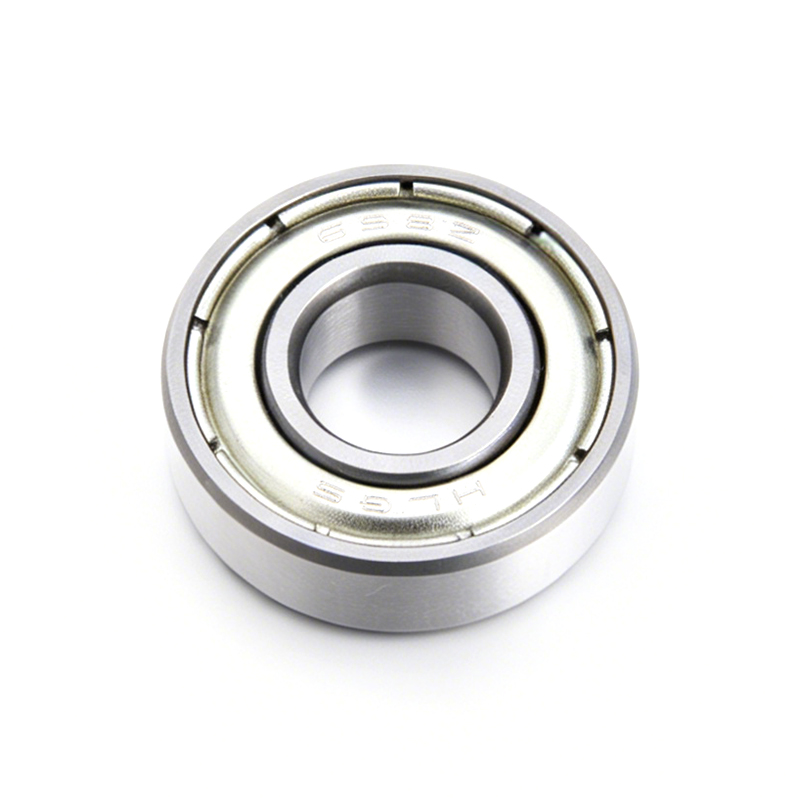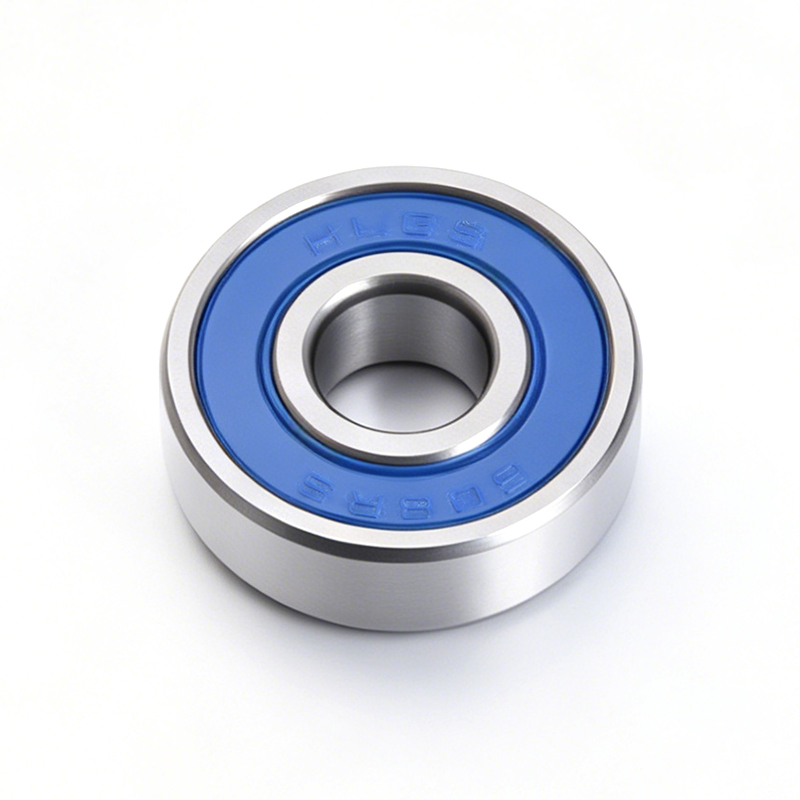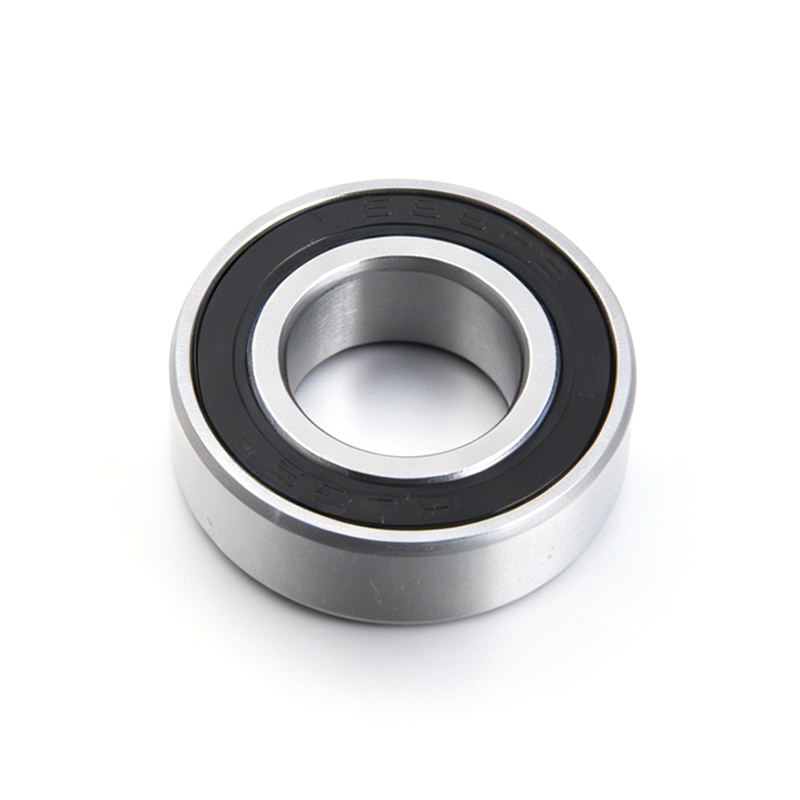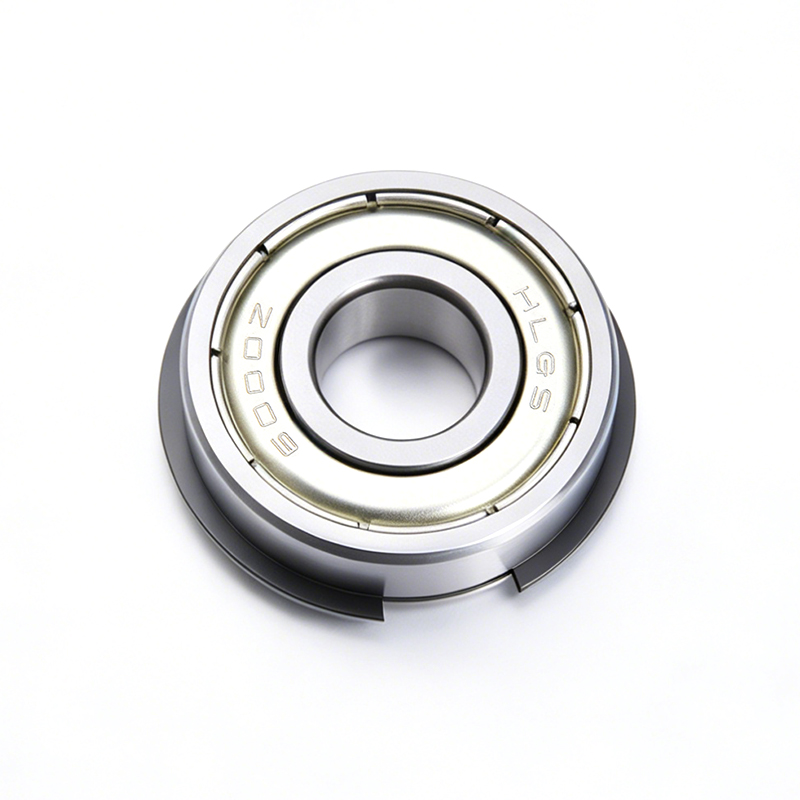
A spindle starts to leave a faint chatter mark at 8,000 rpm. The deep groove ball bearing meets its published load rating, yet the shaft deflects axially far more than the design budget allows. This is a familiar scene in precision machinery: the load number was checked, but the stiffness number was never specified. Axial stiffness determines how much a shaft moves when an axial force acts on it, and in equipment such as small motors, robots, and measuring devices, that movement matters as much as bearing life. This article explains what axial stiffness means, which design variables govern it, and how to make sure the bearing you select behaves as stiffly as the application requires.
Axial stiffness is the ratio of an applied axial load to the resulting axial deflection, expressed in newtons per millimetre. For a deep groove ball bearing, this ratio is not constant. The deflection between balls and raceways follows Hertzian contact behaviour: as the load increases, the contact area grows, the deflection becomes proportionally smaller, and the bearing appears stiffer. In other words, stiffness rises with load.
To put a number on it, a small 608-size deep groove ball bearing might show an axial stiffness in the range of 30 to 80 N/µm depending on its clearance and the load level. A larger bearing such as a 6205 can reach several hundred N/µm under the same conditions. These figures are not fixed ratings; they are snapshots of one specific load point on a nonlinear curve.
A deep groove ball bearing is symmetrical in the axial direction, meaning it can carry axial loads in both directions. Yet this symmetry has a consequence that design engineers often overlook. The bearing is built with internal radial clearance, so the balls do not contact the two raceway shoulders simultaneously. Under a small axial force, the shaft moves almost freely through the clearance until the balls seat on one shoulder. The axial stiffness in this region is effectively zero, and only after that play is consumed does the bearing begin to resist the load with its true contact stiffness.
A load rating answers one question: how much load can the bearing survive? Axial stiffness answers a different question: how precisely will the bearing hold the shaft? For many products, the second question is what determines quality. A small motor that allows rotor displacement generates vibration and noise. A robotic joint with excessive axial play loses positioning repeatability. A precision spindle that deflects under cutting force creates chatter and poor surface finish.
Consider a motor whose rotor is positioned by two deep groove ball bearings. If the axial clearance at the raceway shoulder leaves 15 µm of free travel, the rotor shifts back and forth with every reversal of the magnetic force. The resulting axial motion directly translates into audible noise and repeated micro-impacts between balls and raceway shoulder. A preloaded bearing or a reduced-clearance bearing eliminates this behaviour at the source.
None of these failures requires the bearing to be anywhere near its load limit. The bearing simply is not stiff enough for the structural loop of the machine. That is why stiffness data should be treated as a first-class specification, not a datasheet afterthought. When an assembly is designed to keep axial movement within two microns, a bearing that deflects ten microns under the same force makes every other precision component in the system pointless.
The table below lists the parameters that most directly affect the axial stiffness of a deep groove ball bearing. The trade-offs matter as much as the stiffness improvement itself.
| Parameter | Effect on axial stiffness | Practical trade-off |
|---|---|---|
| Internal clearance | Smaller clearance reduces axial play and increases stiffness | An excessively tight clearance raises friction and heat; the bearing can seize at operating temperature |
| Ball diameter and ball count | Larger or more balls enlarge the contact area, reducing deflection per unit load | More steel means higher torque, higher inertia, and a possible reduction in dynamic capacity |
| Raceway groove radius | A smaller groove radius seats the ball more deeply and raises stiffness | Deep seating generates more heat and demands higher running accuracy |
| Axial preload | Preload removes the clearance dead zone and moves the bearing onto a steeper part of the load-deflection curve | Preload consumes load capacity and adds friction, shortening service life if set too high |
The most common reason for poor axial stiffness in practice is not insufficient ball diameter; it is clearance. Standard deep groove ball bearings are classified into clearance groups such as C2 (smaller than normal), CN (normal), and C3 (larger than normal). Larger clearance simplifies assembly and tolerates thermal expansion, but it also widens the axial displacement zone. For stiffness-critical applications, a C2 or even a custom-reduced clearance is often the simplest way to reduce axial play without changing the bearing geometry.
If the application cannot accept any axial free travel, the next step is preload. A spring pressing axially on the outer ring continuously seats the balls against the raceway, so the bearing operates on the stiffer part of its deflection curve at all times. Rigid preload achieves the same result by fixing both bearing rings so that the balls are always in contact. Both approaches reduce axial play to near zero, but they add friction and generate heat, so preload values must be calculated carefully for the expected operating speed and temperature range.
Deep groove ball bearings are sometimes described as radially dominant, and the description is fair. A radial load is carried along a direct line through the balls and both raceways, while an axial load must transfer through the raceway shoulders and induce a growing contact angle. Because of this geometry, the radial stiffness of a deep groove ball bearing is usually higher than its axial stiffness at the same load. The difference is not a defect; it is a consequence of the bearing's design.
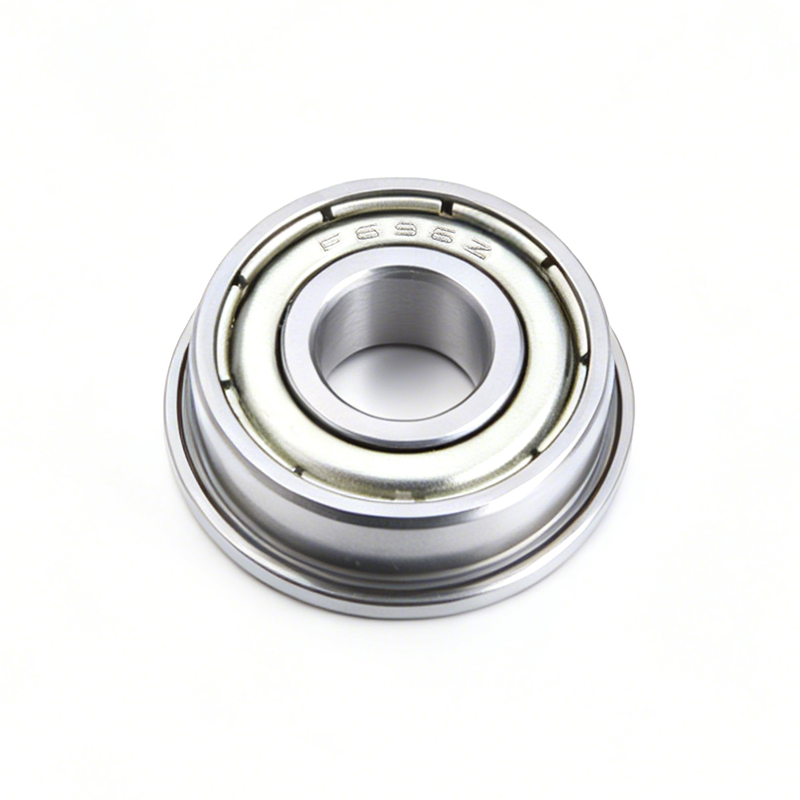
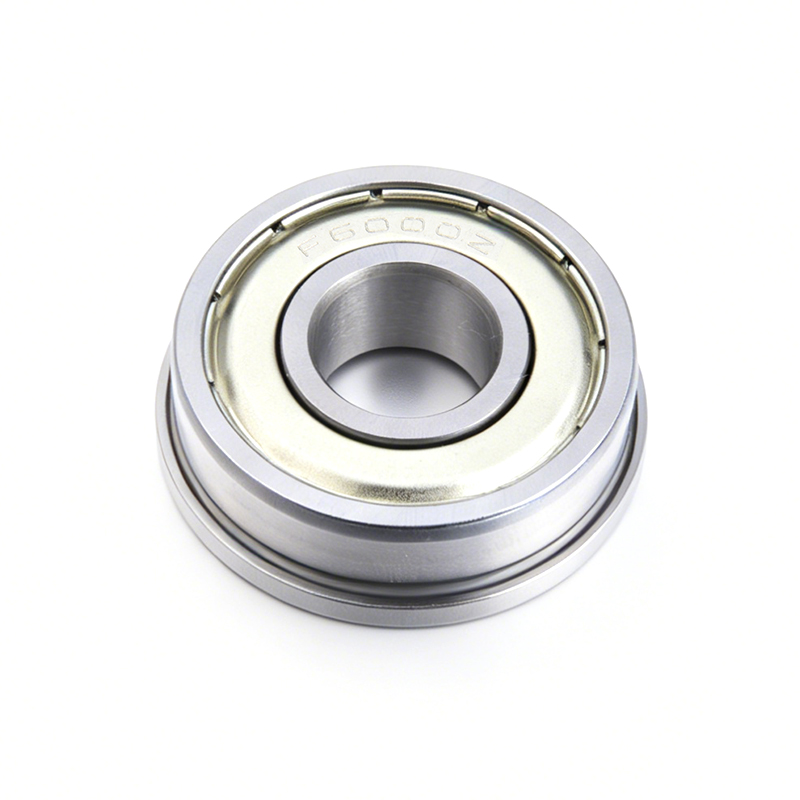
For a shaft that must be located accurately in both directions, the practical solution is often a pair of bearings or a bearing with an integrated flange. Flanged variants register the bearing axially against a housing face and simplify assembly in small electric motors and gear units. The flanged bearing selection guide explains how the flange position and housing fit affect axial shaft location. In motors with restricted space, a shielded flanged bearing such as the F696ZZ flanged bearing provides both axial support and simple housing location without an extra retaining ring.
Wholesale F696ZZ Shielded Flange Bearing Ensures Smooth Running for Small MotorsNingbo Zhenhai Hualei Bearing Co.,Ltd. is China wholesale F696ZZ Shielded Flange Bearing Ensures Smooth Running for Small Motors Supplier...View Product →Theoretical stiffness calculations are a starting point, but the real load-deflection curve depends on manufactured clearance, raceway profile, and ball roundness. A force-deflection test is straightforward: place the bearing on a rigid support, apply an axial load in increments with a calibrated press, and measure the shaft displacement with a displacement sensor. Plotting load against deflection gives a curve whose slope at the operating load is the bearing's tangent stiffness.
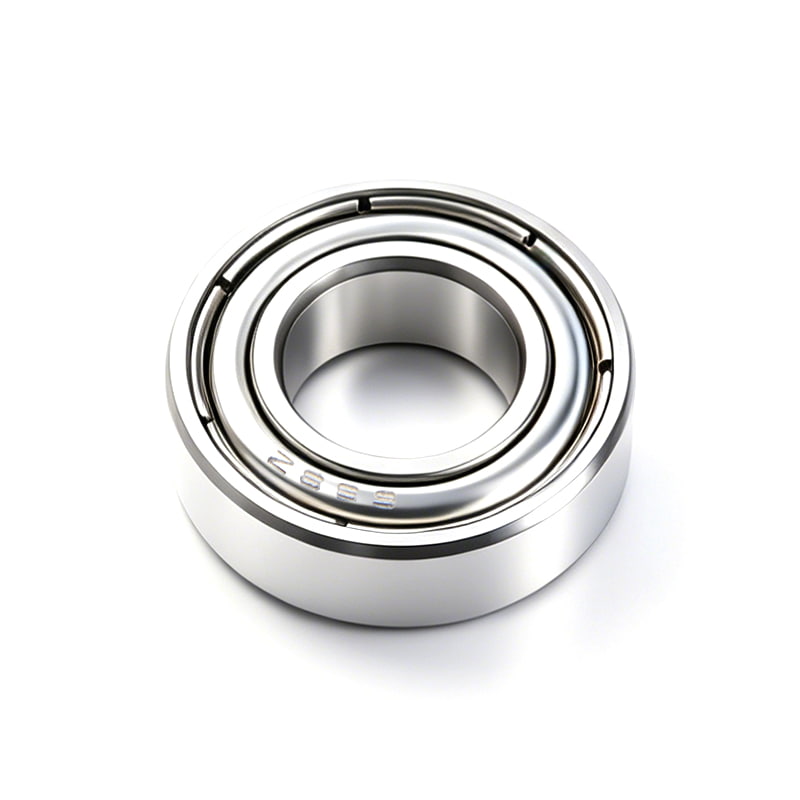
When miniature bearings are involved, the test setup has to be scaled down as well. The deflection at a few newtons of axial load can be just a few micrometres, so the measurement resolution is more demanding than for a large industrial bearing. This is where a bearing supplier with in-house measurement capability makes a difference when you are qualifying a new 688ZZ compact miniature bearing for a precision assembly.
Wholesale 688ZZ Deep Groove Ball Bearing Features a Compact Design Ideal for LigNingbo Zhenhai Hualei Bearing Co.,Ltd. is China wholesale 688ZZ Deep Groove Ball Bearing Features a Compact Design Ideal for Light-Duty A...View Product →
Note that a static load-deflection test measures static stiffness. In a running machine, the bearing also responds to dynamic effects: oil film behaviour between balls and raceways, centrifugal forces on the balls at high speed, and thermal expansion of the rings. For most applications below 60 percent of the bearing speed rating, static stiffness is a reliable basis for comparison. Speed-related softening becomes significant mainly in high-speed spindles, where direct dynamic testing is required.
The selection process should begin with an axial deflection budget, not a load calculation. Decide how much shaft movement the application can tolerate at maximum axial force. Then compare bearing options by their predicted load-deflection behaviour at that specific force, rather than by a single stiffness number taken from a catalogue. Stiffness has no universal rating; it is a function of load, clearance, and preload.
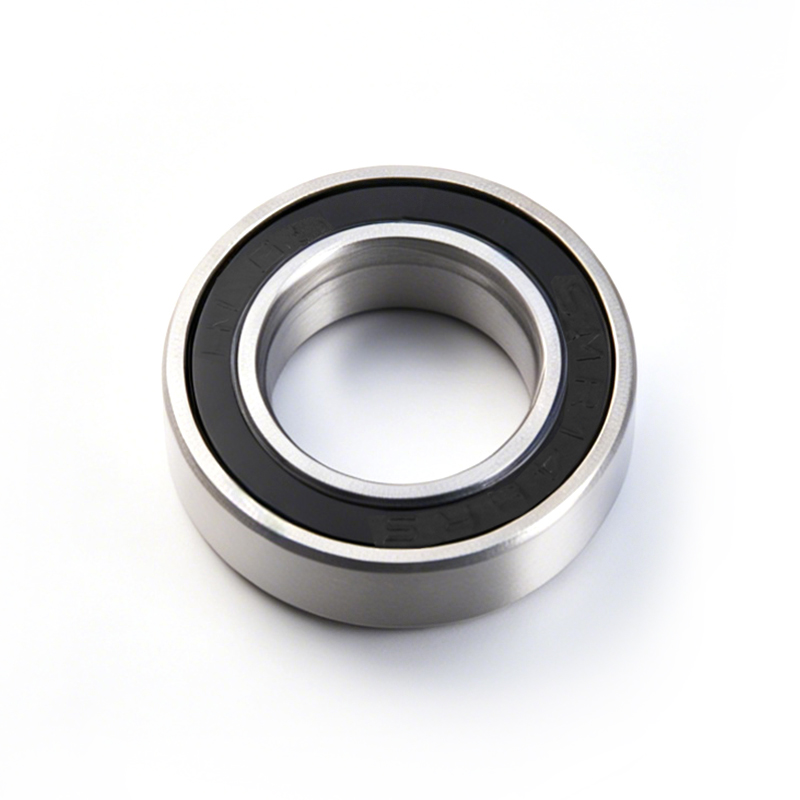
For small motors, robotics, and medical instruments, the direction of the load matters as much as its magnitude. A stainless miniature bearing such as the SMR148-2RS stainless steel bearing offers corrosion resistance and smooth running in environments where the motor is exposed to humidity or cleaning agents. Where space is extremely limited, a compact design keeps the bearing envelope small while still providing predictable axial behaviour through careful clearance selection.
Wholesale SMR148-2RS Miniature Bearing Is Ideal for Small Motors, Robots and MecNingbo Zhenhai Hualei Bearing Co.,Ltd. is China wholesale SMR148-2RS Miniature Bearing Is Ideal for Small Motors, Robots and Mechanical M...View Product →
Bearings selected for stiffness should also be validated in the actual housing and shaft fit. Interference fits change the internal clearance after mounting, and a bearing that appears stiff on a test bench can soften once pressed into a housing. Include the mounting condition in your stiffness evaluation rather than treating the bearing as an isolated component. For a deeper look at how small bearings support precision systems, see our overview of how miniature bearings power precision engineering and high-speed machinery.
If you are selecting a deep groove ball bearing for a motor, pump, or gearbox, the first question i...
The Direct Answer: A Deep Groove Ball Bearing Supports Both Radial and Axial Loads Using a Simple, ...
A motor that has run for years rarely announces a bearing failure early. The first sign is a low hu...
The Direct Answer: Match Precision Class to Rotational Accuracy Needs, Not to the Highest Available...